
8 June, 2026 – We are delighted to announce that two KM3NeT early-career scientists, Francesco Benfenati Gualandi and Alfonso Lazo Pedrajas, have been awarded with the 2025 GNN dissertation prize.
The prize, which is assigned annually by the Global Neutrino Network (GNN) through an international evaluation committee, is meant to recognise young scientists who have written an outstanding thesis and contributed significantly to the project. Primary criteria of the selection are the scientific quality, the didactics and the form of the thesis.
The awards of the ninth edition of the contest, which was opened in 2025, were announced during a recent meeting of GNN in Amsterdam (the Netherlands) – out of the three awardees, two are KM3NeT members:
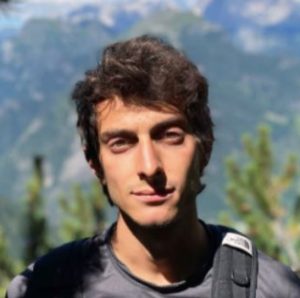
Francesco Benfenati Gualandi was awarded for his thesis “The KM3NeT Experiment: Methods for Time, Position and Pointing Calibration of the Detector” at University of Bologna (Italy). In his work, Francesco addressed the precise time synchronisation and positioning of the telescope’s optical sensors that underpin the energy and angular resolution needed to search for neutrino sources. He contributed significantly to the new White Rabbit network architecture, achieving sub-nanosecond synchronisation of the optical modules, work that fed into the design of the next phase of construction of the apparatus and allowed starting a collaboration with CERN’s White Rabbit team. He also developed the pointing analysis exploiting the Moon-induced deficit in atmospheric muons, that helped establish the equatorial coordinates of the 220 PeV event KM3-230213A reported in the 2025 Nature paper on KM3NeT’s ultra-high-energy neutrino observation.
The committee classified Francesco’s work as an “Incredibly impressive thesis” and praised his “strong technical understanding” which allowed him to conduct “a tour de force” of activities “in a challenging environment”.
You can read Francesco’s thesis here: https://amsdottorato.unibo.it/id/eprint/12336/
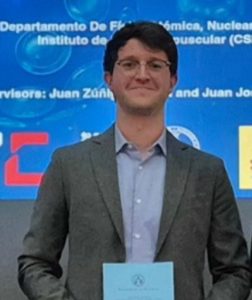
Alfonso Lazo Pedrajas was awarded for his thesis “Neutrino oscillations and search for Non-Standard Neutrino Interactions with KM3NeT/ORCA“ at University of València (Spain). In his work, Alfonso used atmospheric neutrinos detected with KM3NeT/ORCA to measure neutrino oscillation parameters and to search for Non-Standard neutrino Interactions (NSI). For this purpose, he designed Boosted Decision Tree event selections that delivered high-purity neutrino samples from the early detector configuration, and built the first comprehensive Bayesian analysis framework within the KM3NeT software, an adaptive Metropolis–Hastings MCMC implementation. With it, he produced the first Bayesian measurement of atmospheric neutrino oscillation parameters with ORCA and set NSI constraints competitive with the world’s leading limits, despite the detector’s early stage of deployment.
The committee recognised Alfonso’s thesis as “a really high-quality body of work”, with such a variety of “real contributions to both high-level and low-level analysis” that the reviewers were “impressed throughout”.
You can read Alfonso’s thesis here: https://inspirehep.net/literature/3090864
Congratulations, Francesco and Alfonso, and many thanks for contributing your excellent work to KM3NeT!