
 What is a DOM? (in plain English)
Imagine a smart, high-tech camera floating 3,500 meters underwater in the Mediterranean Sea. It watches for flashes of blue light caused by invisible particles passing through the sea. The generated light is called Cherenkov radiation. With 31 small light sensors the camera is looking in every direction. We call the camera the Digital Optical Module or DOM. The DOM helps scientists study neutrinos, some the of most mysterious particles in the universe.
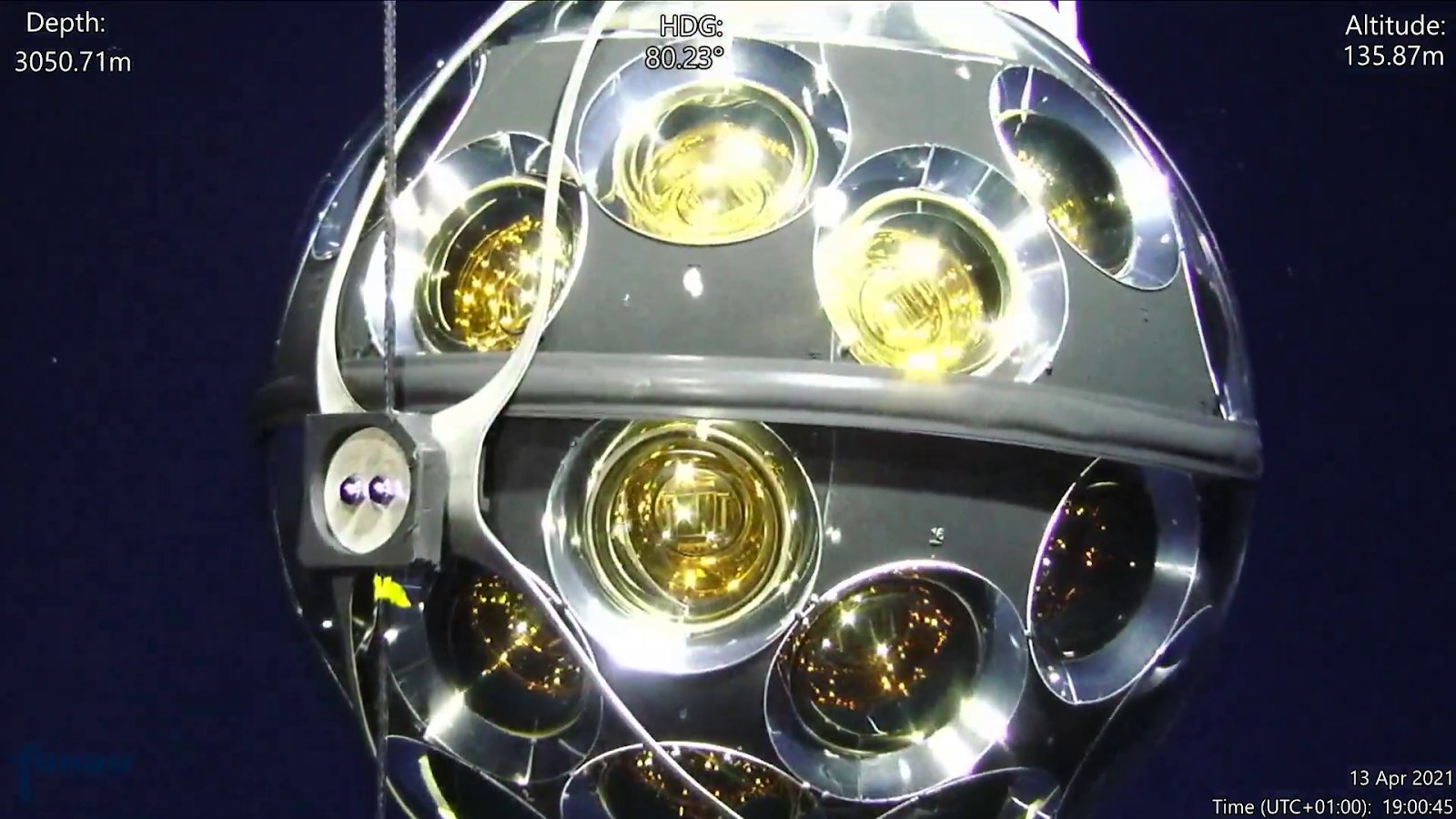
DOMs in the KM3NeT detectors
The ARCA and ORCA detectors of the KM3NeT neutrino telescope are three-dimensional arrays of sensor modules distributed over large volumes of transparent water in the deep Mediterranean Sea. The sensor modules are pressure-resistant glass spheres housing multiple photomultiplier tubes (PMTs) for light detection and several instruments to determine the geometrical position of the sensor modules and to calibrate the measured signals.
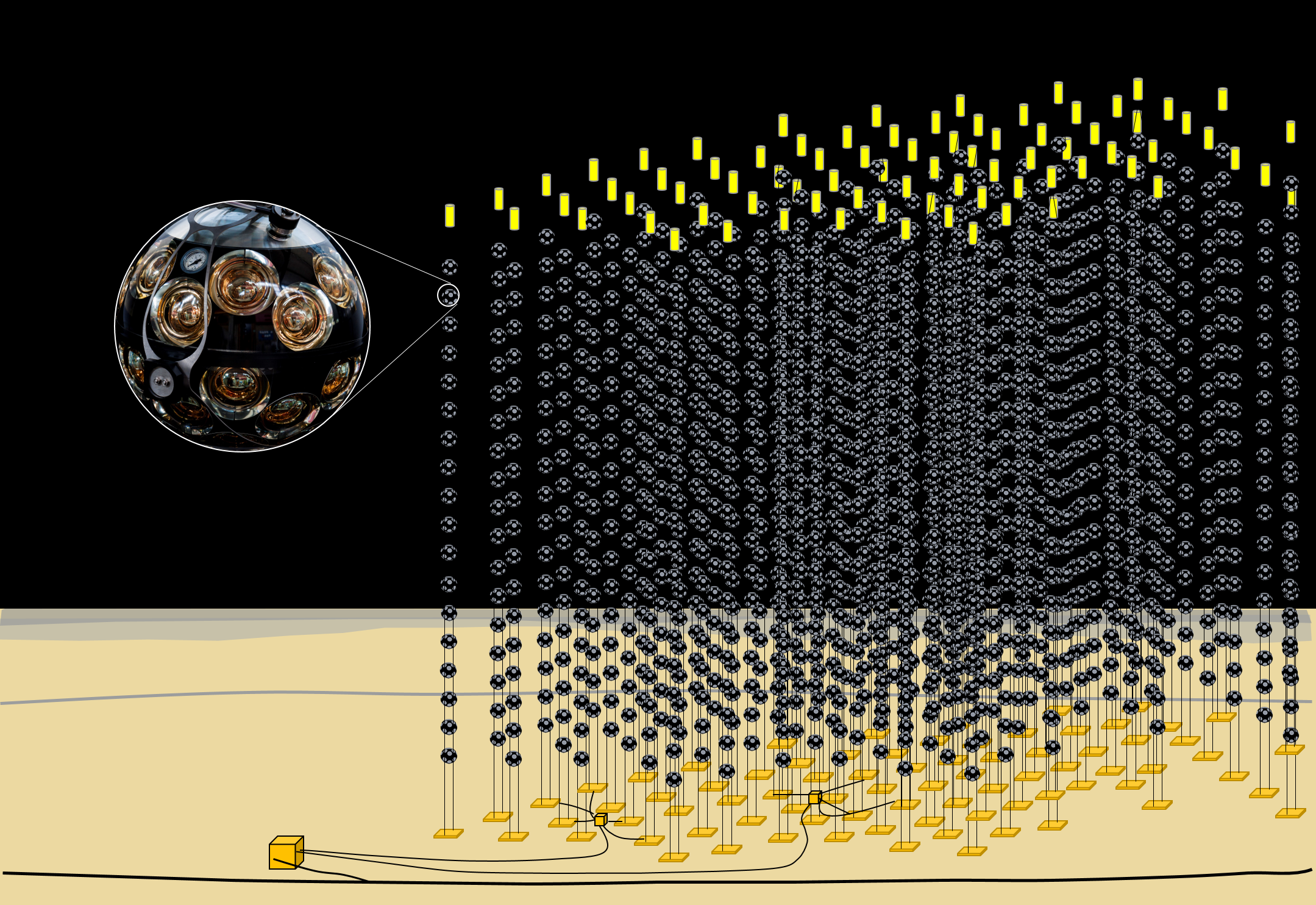
We refer to the sensor module as Digital Optical Module or DOM for short.

 Key concepts
 How the DOM detects neutrinos
Here is the step-by-step process from neutrino interaction to data analysis:
- Neutrino interaction: A neutrino collides with water molecules, creating charged particles that generate flashes of blue light (Cherenkov radiation or Cherenkov light).
- Light detection: The PMTs inside the DOM catch the photons and convert them to electrical pulses.
- Pulse processing: The signals are amplified and converted to square waves using the time-over-threshold technique.
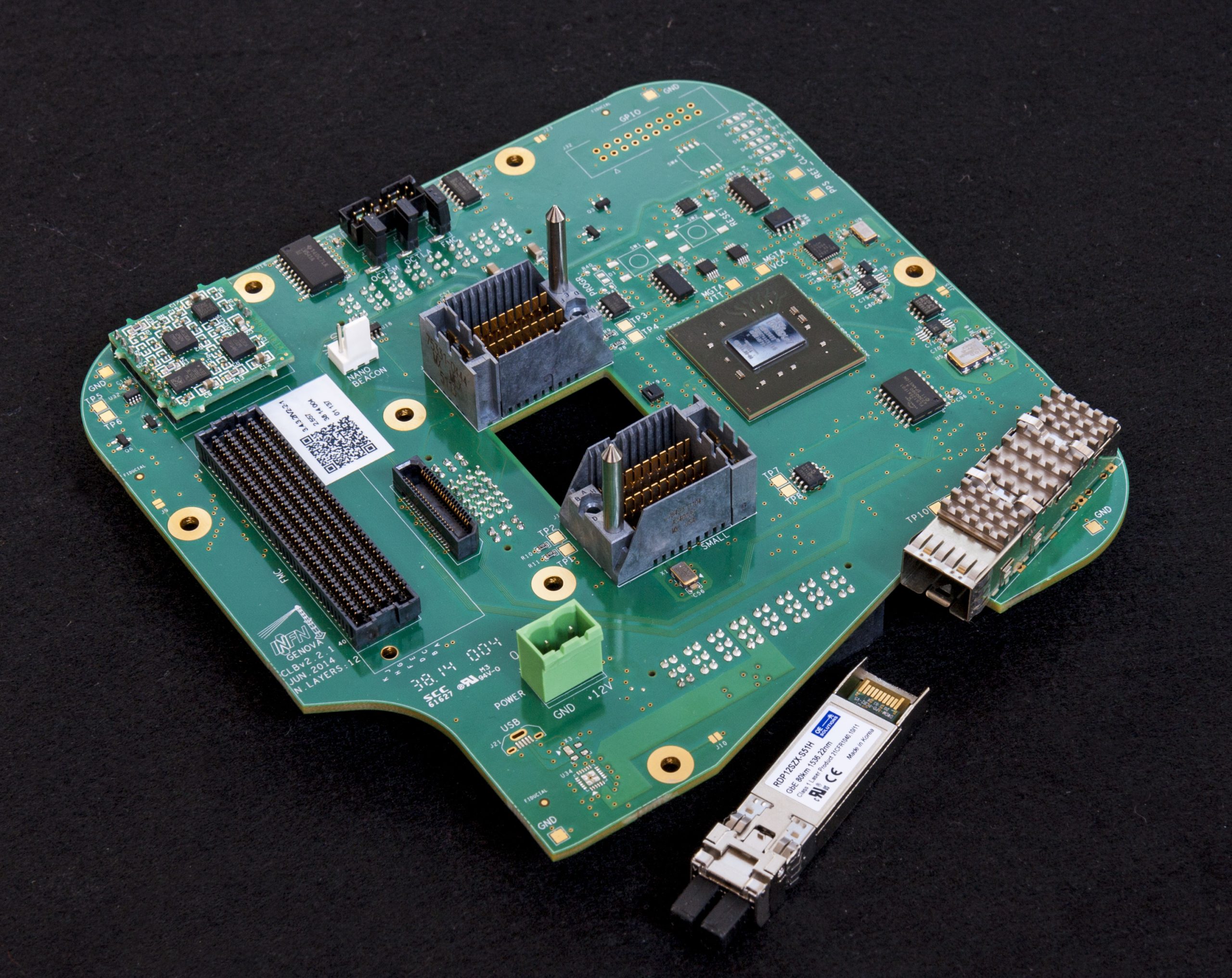
- FPGA analysis: The FPGA inside the DOM registers in nanoseconds precision the arrival time of the photons and the pulse length and prepares the transmission of the measured data.
- Data transmission: The measurements travel via a network of optical fibres to the control station on shore for filtering and reconstruction of the trajectories of the particles that traversed the KM3NeT detector.
- Long term data storage: The results are sent over the public internet from the control station to the KM3NeT data centres and stored for further study by the scientists.
 Technology of the KM3NeT multi-PMT DOM
Glass sphere
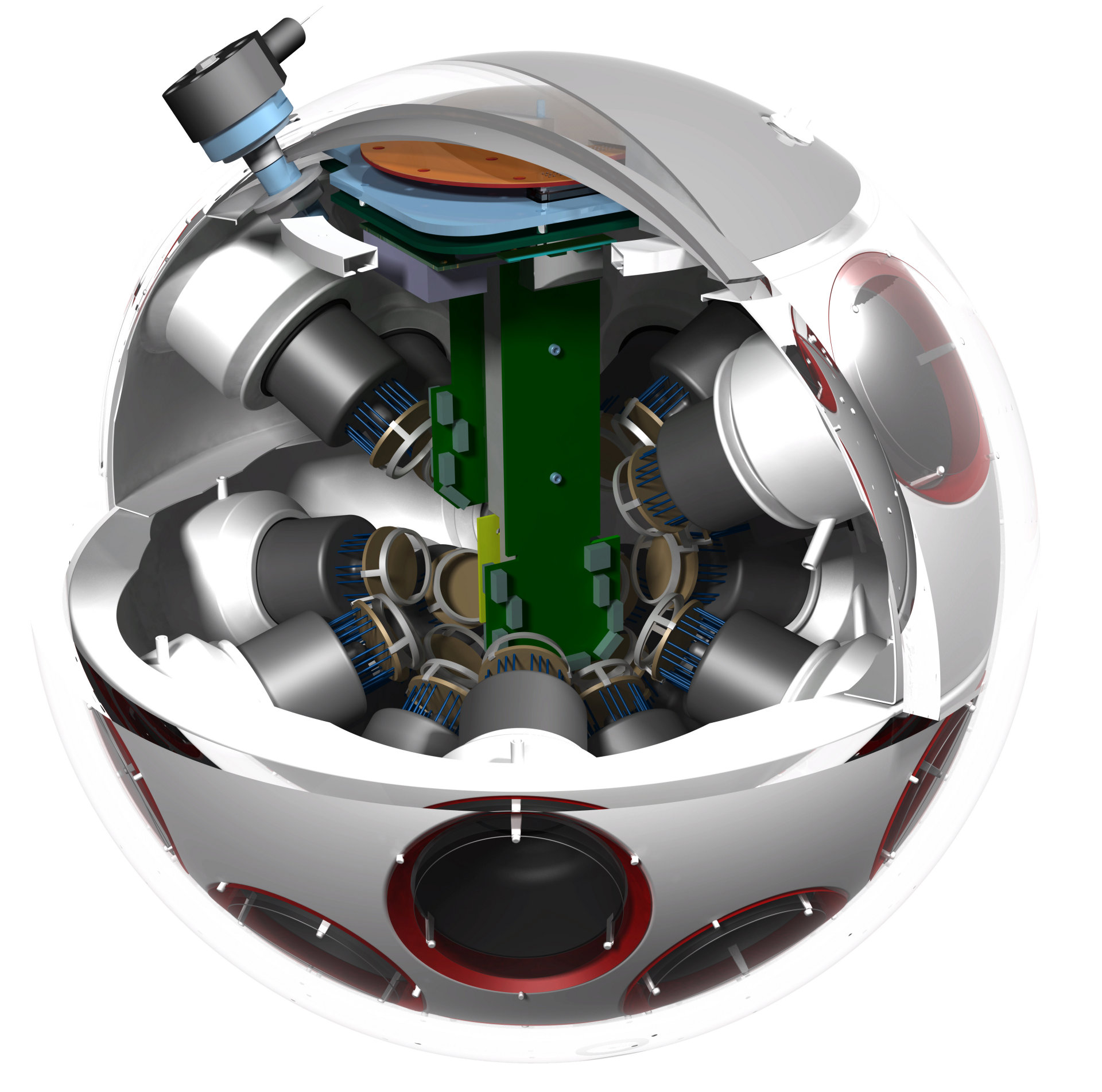
A DOM consists of a glass spherical vessel with a wall thickness sufficient to withstand the enormous pressure of up to 350 times normal atmospheric pressure that exists at the bottom of the Mediterranean Sea where the KM3NeT detectors are installed.
Multi-PMT architecture
In the glass sphere 31 photomultiplier tubes (PMTs) have been arranged to look in all directions for the faint light emitted by particles passing by. Together they form a ‘fly’s eye’ camera, allowing for precise 3D reconstruction of the trajectory of particles passing the detector.
PMT base
The photomultiplier tubes need to be provided with a high voltage of around 1000V. This is provided by a custom made electronic circuit on the back of the photomultiplier tube. The electronic board has been miniaturised in order to fit in the limited space available inside the glass sphere.
Pulse processing pipeline
When a photon hits a photomultiplier tube it creates a small electrical pulse. The pulse is amplified and transformed into a square wave pulse by the time-over-threshold technique. In this proces the amount of light is transformed to an amount of charge which is in turn translated to the length of the square wave pulse. The Field Programmable Gate Array (FPGA) of the central logic in the DOM registers the arrival time of the squared pulse and its length. It prepares these measurements for transmission to the control station on shore.
Other sensors
For calibration purposes the DOM also contains other sensors. A compass to measure the direction in which each of the photomultipliers is pointing. Accelerometers to measure the tilt, pitch and yaw of the DOM. A piezo-acoustic sensor to determine the geometrical position of the DOM in 3D using a sonar technique.
Moving DOMs
All calibration measurements are important as the DOM moves under the influence of sea currents. Therefore, its position and orientation must be monitored very regularly.
 Assembling the DOM
Assembling the multi-PMT optical module requires highly-skilled technicians: see this sneek peak into one of the KM3NeT production labs in Amsterdam, The Netherlands.
Or this animated report of a workshop about assembling optical modules in the CAPACITY lab in Caserta, Italy:
 Prototyping & Validation
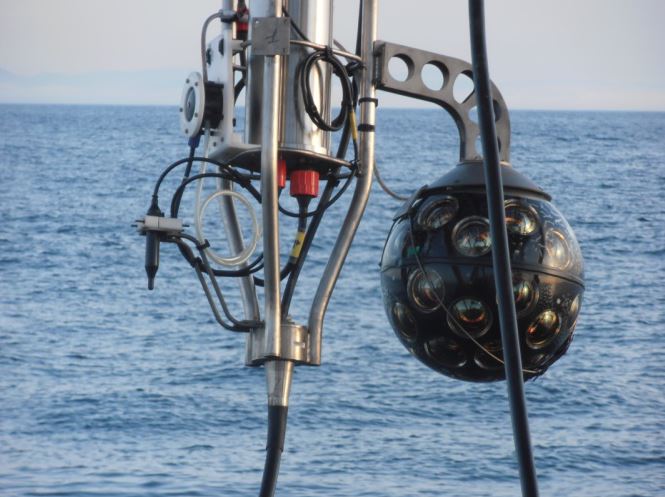
Important in the development of the DOM is in situ prototype validation:
- In May 2013, a prototype DOM was successfully installed on an ANTARES detector line.
- In May 2014, a prototype string comprising three DOMs was successfully deployed and connected to the KM3NeT-It site at 3500 m depth.
- Validation: Both prototypes operated for more than a year thus providing not only a validation of the technologies, but also a check of the detection capability via the comparison of the response of the prototypes to background light from the decay of radioactive potassium-40 (40K) in the sea water and from atmospheric muons expected from Monte Carlo simulation with data.
 Scientific Publications
- The KM3NeT multi-PMT optical module, The KM3NeT Collaboration, S. Aiello et al., 2022 JINST 17 P0703
- Deep sea tests of a prototype of the KM3NeT digital optical module, The KM3NeT Collaboration: S. Adrián-Martínez et al., Eur. Phys. J. C (2014) 74: 3056