
23 November 2026 – We present a new paper with the title ‘KM3NeT/ARCA stacking search for high-energy neutrino point sources: the case of ultra-luminous infrared galaxies and blazars‘.
In the paper we present a search for high-energy neutrino emission of extreme objects in the Universe.
In a stacking search, signals from astronomical objects are combined to increase the sensitivity of our neutrino telescope. We selected possible sources from astronomical catalogues, estimated their combined neutrino flux and compared the result with data measured with the ARCA detector of KM3NeT.
In particular, we selected 75 sources in ultra-luminous infrared galaxies, 232 high-synchrotron-peaked blazars and 88 extremely-high-synchrotron-peaked emitting blazars. Blazars have relativistic jets orientated close to the line of sight. Neutrinos are generated when hadrons, accelerated in the jet, produce pions, which decay into neutrinos.
For the comparison we selected 1544 track-like neutrino candidates measured with the ARCA detector of KM3NeT in partial configurations of 15 and 21 detection units.
We did not find a statistically significant excess in the neutrino flux above the background of atmospheric neutrinos. Therefore, we set 90% confidence level upper limits for high-energy neutrino emission of the three selected types of extreme objects in the Universe.
In the case of extremely-high-energy-peaked blazars the upper limit is approaching the range of fluxes predicted by the theoretical model.
The paper has been submitted to European Physics Journal C and is available as a preprint at arXiv: 2609.03609
In the picture a map of the astronomical sources that we used in our stacking search.
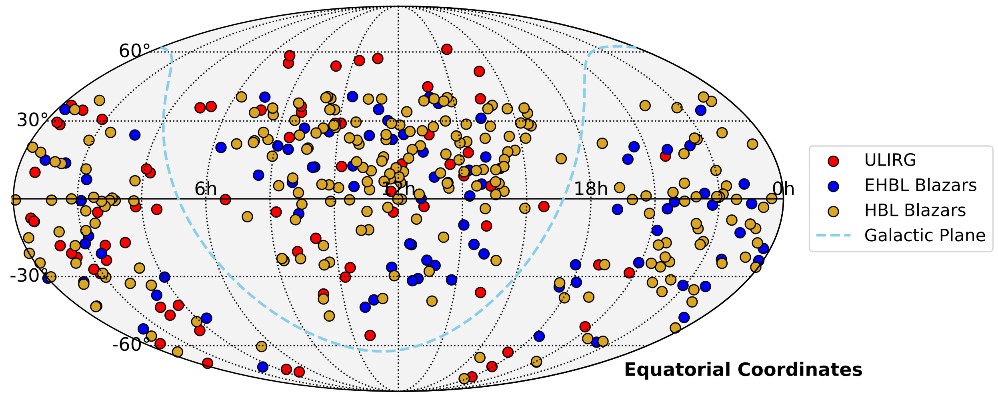
Red dots: ultra-luminous infrared galaxies. Orange dots: high-synchrotron-peaked blazars. Blue dots: extremely-high-synchrotron-peaked blazars.