
🔍 What is a DOM? (in plain English)
Imagine a high-tech “eye” sitting 3,500 meters underwater. It watches for flashes of blue light caused by neutrinos passing through the sea. The generated light is called Cherenkov radiation. Each “eye” contains 31 small sensors looking in every direction. We call the “eye” the Digital Optical Module or DOM. The DOMs can withstand a pressure of 350 atmosphere. They help scientists study some the of the universe’s most mysterious particles – the neutrinos.
Overview
The ARCA and ORCA detectors of the KM3NeT neutrino telescope are three-dimensional arrays of sensor modules distributed over large volumes of transparent water in the deep Mediterranean Sea. The sensor modules are pressure-resistant glass spheres housing multiple photomultiplier tubes for light detection and several instruments to determine the geometrical position of the sensor modules and to calibrate the measured signals.
We refer to the sensor module as Digital Optical Module or DOM for short.

📚 Key concepts
⚙️ How the DOM detects neutrinos
Here’s the step-by-step process from neutrino interaction to data analysis:
- Neutrino interaction – A neutrino collides with water molecules, creating charged particles that generate flashes of blue light (Cherenkov radiation).
- Light detection – PMTs inside the DOM catches the photons and convert them to electrical pulses.
- Pulse processing – The signals are amplified and converted to square waves using the time-over-threshold technique.
- FPGA analysis – The FPGA registers the arrival time (nanosecond precision) and pulse length, storing data for transfer.
- Data transmission – Measurements travel via optical fibers to the control station on shore for filtering and reconstruction.
🔬 Technical Specifications
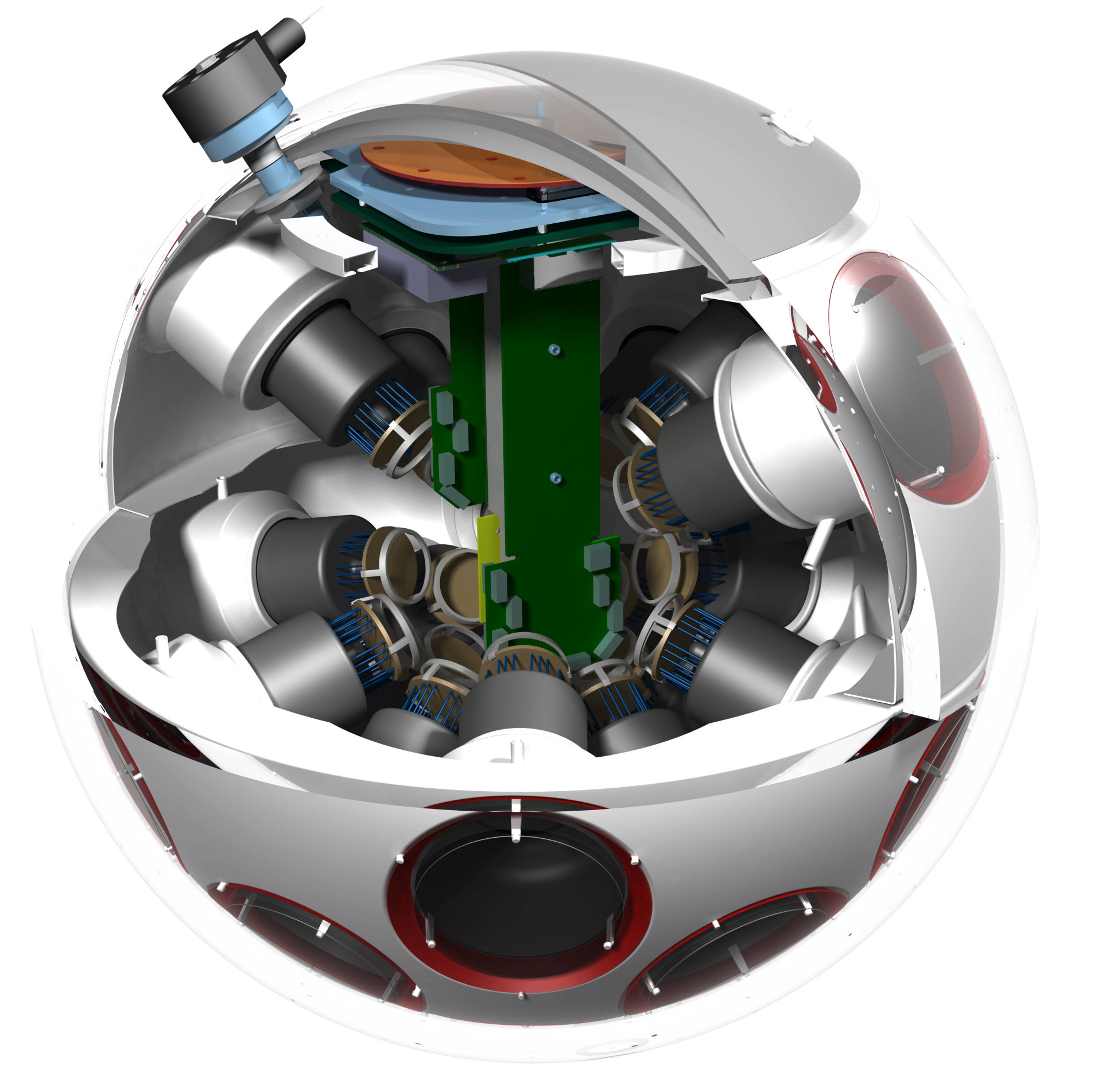
A multi-PMT DOM consists of a glass spherical vessel and has the following technical specifications:
| Feature | Specification |
|---|---|
| Pressure Resistance | Up to 350 atm (3,500m depth) |
| Photomultiplier Tubes | 31 x 3-inch PMTs (Multi-PMT) |
| Operating Voltage | ~1000V per PMT |
| Processing Unit | FPGA (Field Programmable Gate Array) |
| Calibration Sensors | Compass, Accelerometers, Piezo-acoustic |
| Glass Sphere | Sodium borosilicate, 17mm thick |
Why 31 PMTs? Unlike older “single-PMT” modules, the multi-PMT design acts like a “fly’s eye,” allowing precise 3D reconstruction of particle tracks without blind spots.
The DOM not only contains PMTs but also other sensors used for calibration purposes. A compass makes it possible to know in what direction each of the photomultipliers is pointing. Accelerometers allow tilt, pitch and yaw of the module to be determined. A piezo-acoustic sensor allows for the determination of the position of the DOM in 3D using a sonar technique. All these measurements are important as the DOMs move under the influence of sea currents.
🔧 Assembling the DOM
Assembling the multi-PMT DOM requires highly-skilled technicians. Watch these videos to see the process:
- Sneak peek into the KM3NeT production lab in Amsterdam, The Netherlands
- Animated report from the CAPACITY lab in Caserta, Italy
🧪 Prototyping & Validation
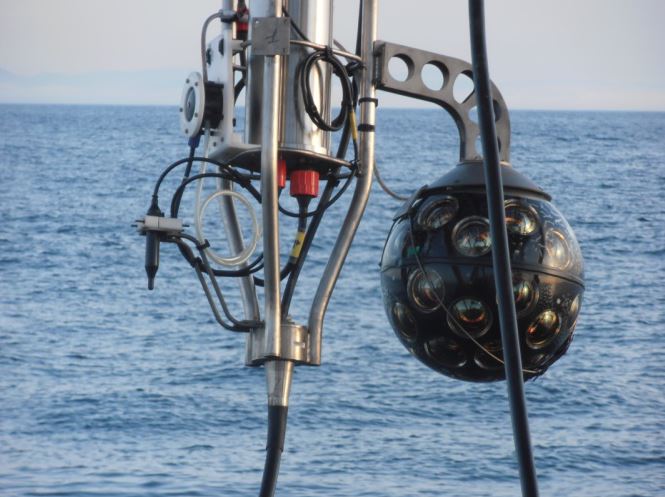
A very important milestone of the project is the in situ prototype validation:
- May 2013: A prototype sensor module was successfully installed on an ANTARES detector line
- May 2014: A prototype string comprising three DOMs was successfully deployed and connected to the KM3NeT-It site at 3,500 m depth
- Validation: Both prototypes operated for more than a year, validating technologies and detection capability
The prototypes checked detection capability via comparison of the response to background light from the decay of radioactive potassium-40 (⁴⁰K) in the sea water and atmospheric muons expected from Monte Carlo simulation with data.
📄 Scientific Publications
Learn more from peer-reviewed journals:
- The KM3NeT multi-PMT optical module
The KM3NeT Collaboration, S. Aiello et al.
2022 JINST 17 P0703 - Deep sea tests of a prototype of the KM3NeT digital optical module
The KM3NeT Collaboration: S. Adrián-Martínez et al.
Eur. Phys. J. C (2014) 74: 3056